
Controlled Impedance Across Hermetic Boundaries
RF and microwave hermetic feedthroughs transmit high-frequency signals through sealed housings while maintaining electrical continuity and environmental isolation. Unlike low-frequency electrical feedthroughs, RF designs must account for transmission-line impedance, electromagnetic field distribution, and discontinuities at the enclosure boundary. The conductor diameter, dielectric constant, ground geometry, and transition length can affect signal reflection and transmission loss. For nominal 50-ohm systems, engineers typically seek a controlled-impedance transition compatible with the surrounding RF circuitry. A successful microwave hermetic feedthrough must satisfy both hermetic sealing requirements and the intended frequency-domain performance.
Dielectric Materials and RF Performance
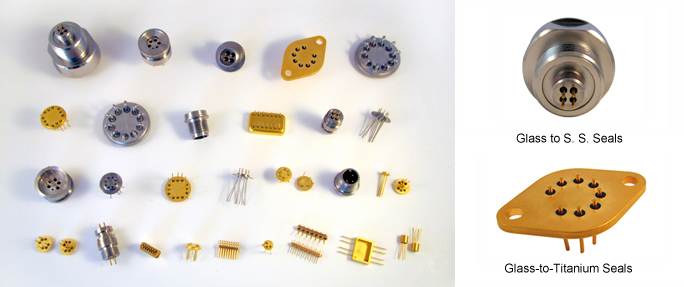
Glass-to-metal seals provide an effective platform for many RF feedthrough designs because glass functions as both a dielectric insulator and a hermetic barrier. However, glass composition and connector geometry influence characteristic impedance and parasitic capacitance. The Complete Hermetics technical documentation identifies representative dielectric constants for several sealing-glass families, including borosilicate and barium-alkali compositions. Engineers should evaluate dielectric loss, impedance discontinuity, conductor geometry, and the surrounding metal reference structure when designing higher-frequency interfaces. Ceramic insulation may also be considered when application requirements favor different thermal, dielectric, or mechanical properties.
S-Parameters and RF Qualification
Electrical qualification of RF hermetic feedthroughs should extend beyond insulation resistance and helium leak testing. Network-analyzer measurements can characterize S-parameters, including insertion loss (S21) and return loss (S11), across the intended operating frequency range. Voltage standing wave ratio (VSWR), impedance matching, and signal attenuation provide additional insight into transition performance. Thermal cycling and mechanical loading should be considered because changes in geometry or sealing integrity can affect both RF and environmental performance. Engineers should define the required frequency range, impedance, power handling, and measurement reference planes before prototype evaluation.
Custom RF Hermetic Solutions from Complete Hermetics
Complete Hermetics identifies RF and microwave feedthroughs among its glass-to-metal sealing capabilities. The company manufactures custom electrical feedthroughs and hermetic assemblies using selected conductor materials, glass compositions, and metallic housings. RF design requirements should be reviewed individually to establish suitable conductor geometry, package integration, and test methods. The company’s broader capabilities also include Glass-to-metal seals, Ceramic-to-metal seals, Hermetic connectors, Hermetic headers, Hermetic packages, Vacuum feedthroughs, Hermetic seals, and custom electronic packaging components.
Get in touch with Complete Hermetics today to discuss RF frequency requirements, impedance targets, hermeticity specifications, and custom feedthrough development.
Contact Complete Hermetics Today:
- Website: www.completehermetics.com
- Contact Form: https://www.completehermetics.com/contact-us/
- Phone: 714-265-1238
- Email: info@completehermetics.com