
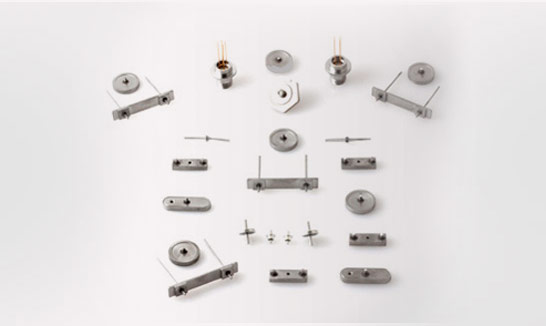
Electrical Isolation in Sealed Battery Enclosures
Hermetic battery end seals provide electrically insulated conductor penetrations through battery lids and terminal assemblies while maintaining a sealed boundary. These components are particularly important in lithium battery systems exposed to demanding mechanical, thermal, or environmental conditions. A typical glass-to-metal battery terminal incorporates a metallic housing, an electrical conductor, and a compatible insulating glass. The seal must maintain electrical isolation while accommodating pressure variations, thermal expansion, and the mechanical constraints of the battery enclosure. Engineers must also consider electrolyte compatibility, corrosion behavior, and potential electrical leakage paths when selecting a terminal design.
Material Selection and Electrochemical Compatibility
Complete Hermetics identifies stainless steel, mild steel, titanium, and aluminum among its available battery end-seal body materials. Conductor options include Alloy 52, molybdenum, stainless steel, and titanium, depending on the electrical and mechanical requirements. Its listed glass materials include Corning 9010, Corning 9013, TA23, Cabal 12, and custom formulations. Material selection must account for CTE compatibility, chemical exposure, operating temperature, and the intended joining process. Because battery chemistries differ, engineers should verify compatibility with the specific electrolyte, enclosure material, and operating conditions rather than assuming a universal sealing solution.
Helium Leak Testing and Electrical Qualification
The performance of hermetic battery terminals is typically evaluated through a combination of leak testing and electrical inspection. The Complete Hermetics website describes 100% leak inspection for its battery end-seal products and identifies a helium leak-rate specification of approximately 1 × 10⁻⁸ cc/s. Additional testing may include insulation resistance and dielectric breakdown voltage, depending on the application. The company describes battery end-seal applications spanning approximately −40°C to above +150°C, subject to the selected design and materials. Qualification should also consider thermal cycling, pressure exposure, corrosion, and the integrity of the completed battery-lid assembly.
Custom Battery Sealing Solutions
Complete Hermetics manufactures custom lithium battery glass-to-metal sealed lids, battery end seals, and electrical terminals for specialized electronic systems. Its capabilities support applications involving medical equipment, communication systems, sensors, monitoring equipment, and industrial electronics. The company also manufactures hermetic headers, hermetic feedthroughs, glass-to-metal seals, and other custom sealing components. Engineering teams can discuss lid dimensions, conductor materials, electrical isolation, leak-rate requirements, and environmental testing during design development.
Get in touch with Complete Hermetics to request custom battery terminal manufacturing and technical assistance with hermetic battery enclosure designs.
- Contact Form: https://www.completehermetics.com/contact-us/
- Phone: 714-265-1238
- Email: info@completehermetics.com