
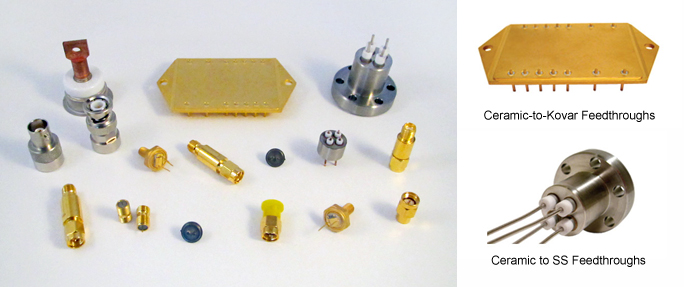
Dielectric Performance in High-Voltage Feedthroughs
Ceramic-to-metal seals are widely specified for electrical feedthrough applications requiring high dielectric strength, elevated operating temperatures, and stable hermetic performance. Unlike conventional polymer-insulated penetrations, ceramic insulators provide a rigid inorganic dielectric barrier between metallic conductors and housings. High-voltage design requires careful evaluation of electric-field distribution, conductor spacing, surface geometry, and insulation material properties. Although ceramics can provide excellent electrical insulation, the complete assembly’s voltage capability depends on geometry, environment, and manufacturing quality. Engineers must consider both bulk dielectric breakdown and surface flashover when designing high-voltage hermetic feedthroughs.
Alumina, Aluminum Nitride, and Metallization
Material selection is central to ceramic-to-metal hermetic sealing because different ceramics provide distinct electrical, thermal, and mechanical properties. Complete Hermetics identifies alumina (Al₂O₃) with purities ranging from 94% to 99%, aluminum nitride (AlN), and beryllium oxide (BeO) among its ceramic insulator options. Alumina is frequently selected for its dielectric properties and mechanical stability, while aluminum nitride offers useful thermal conductivity for certain heat-management applications. Metallization and brazing processes can create a hermetic joint between the ceramic and compatible metallic components. Engineers must evaluate braze alloy selection, thermal expansion mismatch, joint geometry, and residual stress to minimize cracking during fabrication and service.
Temperature, Leak Rate, and Qualification Requirements
High-temperature electrical assemblies require material systems capable of maintaining both insulation and hermeticity throughout the specified operating range. Complete Hermetics lists ceramic-to-metal seal capabilities exceeding 500°C for suitable material and geometry combinations. Its published technical information also identifies hermeticity capabilities as low as 1 × 10⁻⁹ atm·cc/s helium and typical insulation resistance above 1 GΩ at 100 VDC. These values describe available capabilities rather than universal ratings for every ceramic feedthrough configuration. Application-specific qualification should include helium leak testing, dielectric withstand testing, thermal cycling, and mechanical inspection where required.
Custom High-Voltage Ceramic Sealing Solutions
Complete Hermetics designs and manufactures custom ceramic-to-metal seals, high-voltage hermetic feedthroughs, and specialized electrical assemblies. Available housing and conductor materials include stainless steels, Kovar, titanium, Inconel, and selected copper alloys. Its engineering team can evaluate insulator composition, conductor geometry, braze interfaces, and environmental requirements for specialized applications. These capabilities support aerospace, energy, vacuum processing, and industrial instrumentation systems requiring engineered ceramic insulation.
Contact Complete Hermetics to discuss high-voltage ratings, ceramic material selection, leak-rate specifications, and custom feedthrough production.
Contact Info:
- Contact Form: https://www.completehermetics.com/contact-us/
- Phone: 714-265-1238
- Email: info@completehermetics.com