
Understanding Compression Seal Mechanics
Compression glass-to-metal seals use controlled differences in thermal expansion between a metallic housing and an insulating glass to generate residual compressive stress after cooling. During manufacturing, the glass is heated until it bonds to the surrounding metal and conductor surfaces. As the assembly cools, the housing contracts more than the glass, creating radial compression that supports mechanical integrity and hermetic performance. This mechanism distinguishes compression seals from matched glass-to-metal seals, where compatible thermal expansion characteristics minimize residual stress. Engineers selecting compression sealing technology must evaluate housing geometry, glass composition, conductor material, and anticipated service conditions together.
CTE Mismatch and Material Compatibility
The coefficient of thermal expansion (CTE) is a critical parameter in compression seal design because excessive mismatch can create damaging stresses rather than beneficial compression. Common housing materials include stainless steel, cold-rolled steel, and Inconel, while conductor options may include Alloy 52, copper-cored Alloy 52, and Alloy 42. Glass compositions such as Corning 9010 and 9013 are among the materials identified by Complete Hermetics for compression-seal applications. Engineers should consider glass transition behavior, cooling profiles, wall thickness, and conductor spacing when evaluating residual stresses. Finite element analysis and prototype testing can help identify potential fracture locations before production tooling is finalized.
Pressure Resistance and Hermetic Qualification
High-pressure hermetic seals require more than a strong glass-to-metal bond because mechanical loading can affect the housing, conductors, and sealing interface differently. The Complete Hermetics website describes compression-seal applications with working pressures reaching approximately 14,000 psi for suitable designs. However, allowable pressure must be established for the actual geometry, material combination, operating temperature, and safety requirements. Helium mass-spectrometer leak testing provides a means of evaluating hermetic integrity, while insulation resistance and dielectric testing establish electrical performance. Thermal cycling and pressure testing should be included when the assembly will experience repeated environmental loading.
Custom Compression Seals from Complete Hermetics
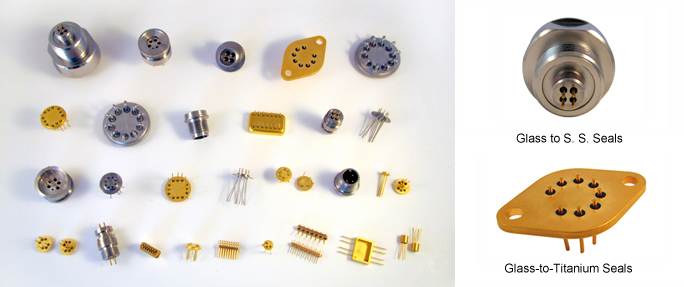
Complete Hermetics manufactures custom compression glass-to-metal seals, electrical feedthroughs, and hermetic terminals for applications requiring high mechanical strength and environmental isolation. Its engineering capabilities include material selection, conductor configuration, sealing-glass selection, and surface finishing. Available plating options include gold, silver, nickel, and tin, depending on the required electrical interface and downstream assembly process. Customers developing pressure-resistant instrumentation, industrial sensors, or sealed electronic assemblies can request application-specific engineering support. Contact Complete Hermetics to discuss compression-seal geometry, pressure requirements, leak-rate targets, and prototype manufacturing.
Contact Us Today
📞 Phone: 714-265-1238
📧 Email: info@completehermetics.com
🔗 Contact Form